Business & Innovation
Manage innovations not only as processes, but also as a portfolio!
This piece writes on the summary and a short reflection on the article “Managing Your Innovation Portfolio” by Harvard Business School.

Key ideas and findings of the article:
- There are three levels of innovation ambitions: (a) enhancements to core offerings, (b) pursuit of adjacent opportunities, and (c) ventures into transformational territory.
- With the above innovation classification, there exists a “golden ratio to invest in innovative initiatives” for a firm to thrive and outperform the others: 70% to core business improvement, 20% to adjacent market potential, and 10% to high-risk disruptive initiatives. For sure, the “golden ratio” varies across industries.
- Following the strategy, the return on innovations holds an inverse ratio to the investments. Roughly speaking, a 70% investment on core business gives a certain 10% profit increment, and a 10% investment on disruptive ideas gives a risky 70% returns.
- Five keys of the total innovation systems: Talentallocation and management across different innovation ambitions. Integrationof skills and associated activities with the day-to-day business. Funding should be sustained by the relevant business unit’s P&L through annual budget cycle, and should not exist as an “innovation tax” (where all business units have to contribute a specified percentage on innovations annually). Pipeline Management should be in place to track ongoing initiatives and ensure the progress. Metrics on success, be it economic/noneconomic or internal/external, should depend on the specific innovation initiatives, and should not be introduced to transformational initiatives at an early stage.
“Rather than hoping that their future will emerge from a collection of ad hoc efforts, smart firms manage for total innovation.”
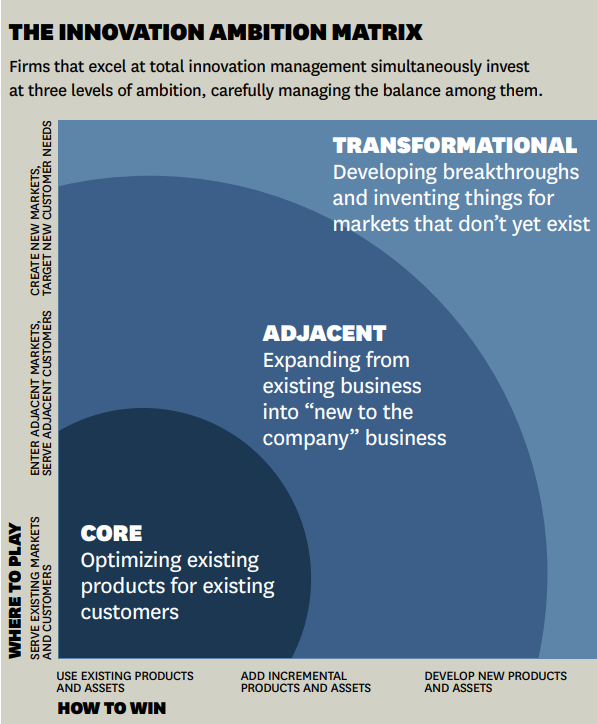
The innovation ambition matrix, a variant of Ansoff matrix, reminds you what you should leverage on to target on your audience for your innovation. Different innovation ambitions should use different resources and serve different TA for success.
There are always trade-offs between all factors and there should be a good balance among all.
Some reflection and discussion:
- Managing the total innovation portfolio is definitely a luxury for small and medium-size enterprises (SMEs). SMEs do not actually have the time and efforts to consider innovation as a portfolio — startups nowadays are probably investing 95% on transformational initiatives to seek a blue ocean of the highly-specialized and productive economy.
- Managing the total innovation portfolio is easier said than done — innovation metrics are not easy to establish; return to innovations could be hard to gauge and compare; companies are not always good at all three types of innovations; not all managements could have the capability in managing innovations. Managing innovation is definitely a trial-and-error process, finding the best allocation and pace for any companies. The same strategy that works in company A may not lead company B to succeed, making it even harder to transfer the learning to others.
- Managing the total innovation portfolio is not just a problem to top managements, but also to many middle-senior managers as well as the company culture. Innovations require all-round support from the company, from every manager and from the team to thrive. An encouraging culture could be the hardest thing to achieve, especially for most Asian companies that appreciate hierarchical relationships.
- The difference of able and unable to manage the total innovation portfolio could just be a difference of a successful and very successful firm. Without total management, the innovations are although uncoordinated, they can still be energetic and profit-boosting. As long as there are supports to innovations, innovations that fit company’s overall strategy still happen and can drive businesses.