How and why you will fail with your past successes?
This piece writes on the summary and a short reflection on the article “The CEO’s Role in Business Model Reinvention” by Harvard Business School.

“Thirty percent of participants in any strategy discussion should be younger than age 30, because they are not wedded to the past.”
Key summaries and ideas of the article:
- Forward-looking CEOs must make use of all information and knowledge of the past, the present and the future to formulate the company strategy and make fine adjustment to the organizational structure with three different approaches .
- Manage the Present — you should be good at data-driven analysis, holding strict accountability for results (KPIs setting for management) and aiming at a perfect alignment of the whole organization such that the best can be arranged and delivered. The company can then run with the highest efficiency and best outputs given the current status and situation.
- Selectively Forget the Past — you should acknowledge that rich data about the future are not available, and you should consider the long-term trend and prepare for any non-linear shifts. To better prepare for the future, anarchy is not an option, and an organization should not aim at perfect alignment for a dynamic future.
- Create the Future — you should create separate, parallel strategy making processes that incorporate non-traditional values (the “30/30 rule”). Running disciplined experiments to learn from the market is essential and this is where the accountability of management lies in. A potential way to organize the company in creating the future is to create zero-based, custom-build sub-units for these projects and experiments.
“If organizational memory is not tamed, it gets in the way of creation. Before you can create, you must forget.”
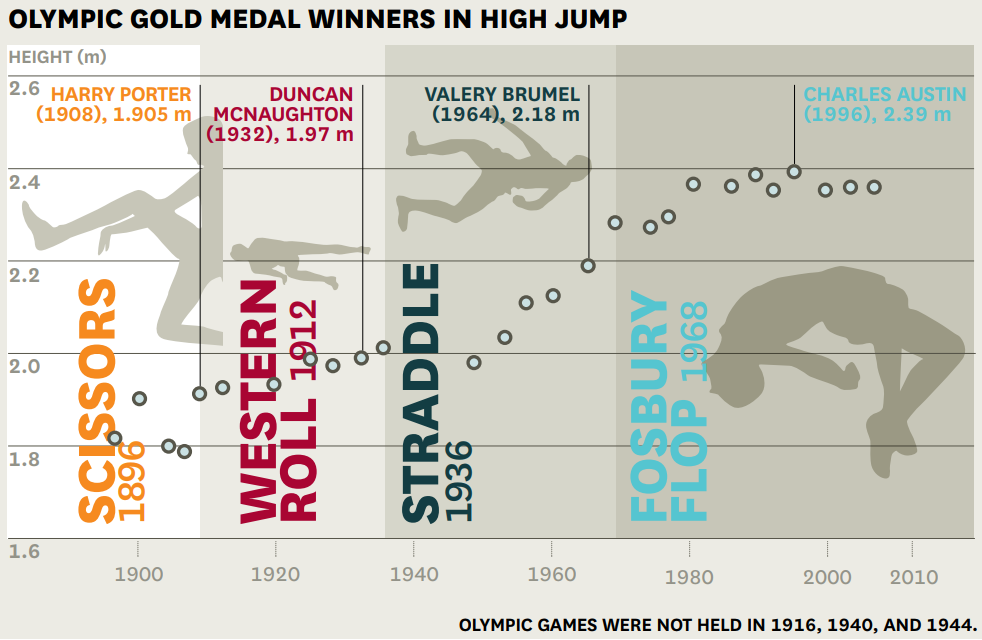
The in-the-air posture evolution of the previous Olympic high jump gold medal winners illustrates the importance of forgetting the past and adapting to nonlinear change. Within the “scissors” period, athletes got trained and competed with the same “scissors” posture until the “Western roll” comes into the market. Breaking through the original obstacle and high-jump limit, the new “Blue Ocean” has been created and led by the creator. Viewing the high jump progression as an industry, only those who can selectively forget the pastand adapt to nonlinear changecould survive and thrive.
Some reflection and discussion:
- The metaphor of the evolution of Olympic high jump gold medal winners is definitely insightful. In a highly competitive industry, it is always hard to compete with the market leader with the best resources, best technologies and the most experiences. Through specialisation, people can only improve the efficiency marginally. Only those who can “break” the market can take the market lead.
- Data-driven analysis is fundamental to a company or a business unit. Before anyone who can create the future, they should first know where and how they stand in their own position. A business should know their comparative advantages over the others and determine their own factors on how they can improve. Only analysis based on true information without data misuse is reliable and can drive real businesses.
- A perfectly aligned team could operate at high efficiency, but could also hinder innovation. For operation teams, it could be good for them to be perfectly aligned; but for others (even for IT teams or audit team where AGILE working approach starts to emerge), it is good to be non-perfectly aligned for innovations to happen. Examples for non-perfectly alignments include some overlapping of team functions, encouraging staff to rotate across teams within departments, etc.
- The “30/30” rule is simple rule of thumb to evaluate your “competencies to innovate”. Despite having less experiences, young colleagues have their edges on new ideas and their exposures to new technologies, especially in the era of speedy technological advancement. Most importantly, they are not bound by the past experiences (because they did not actually experience that).
- To encourage innovations, some good inventive activities could be “strategy graffiti walls”, “knowledge cafes”, “jam sessions”, “speed-geeking” (some of them termed by Infosys) that gather different young employees to improve workflow and processes.